


OFAC Continues to Target Costa Rica-Based Cocaine Trafficking to the United States
WASHINGTON — Today, the Department of the Treasury’s Office of Foreign Assets Control (OFAC) designated five Costa Rican nationals and five Costa Rica-based entities for their involvement in narcotics trafficking and money laundering. A key global cocaine transshipment point, Costa Rica has become an increasingly significant waypoint for criminal organizations trafficking cocaine to the United States. The network designated today is responsible for transporting multi-ton quantities of cocaine from Colombia, storing the drugs in Costa Rica, and ultimately shipping them to the United States and Europe. Luis Manuel Picado Grijalba, the leader of this network, is one of the most prolific drug traffickers operating in the Caribbean.
“The Trump Administration will not allow narcotraffickers to poison Americans,” said Secretary of the Treasury Scott Bessent. “The entire drug trafficking supply chain—from shipping facilitators to money launderers—bears responsibility for American addictions and deaths. We will continue to hold them accountable for the devastation they cause in our homeland.”
Today’s action reflects the culmination of a coordinated Homeland Security Task Force-led investigation involving the Drug Enforcement Administration’s (DEA) San José Country Office and Dallas Field Office, as well as Costa Rica’s Office of the Attorney General, Drug Control Police, Office of Judicial Investigation, Public Force (Fuerza Pública), and Financial Intelligence Unit. OFAC works in close coordination with the Homeland Security Task Forces, which targets the proliferation of illicit drugs and the networks, enablers, and financial mechanisms that support their production and distribution. This unified, whole-of-government approach ensures operational coordination to maximize the impact against transnational criminal networks. This action was taken pursuant to Executive Order (E.O.) 14059, which targets the proliferation of illicit drugs and their means of production.
TREASURY’S DISRUPTION OF COSTA RICAN NARCOTICS TRAFFICKING
Since it opened in 2019, Moín seaport in Limón, Costa Rica, has become a key regional transshipment hub for cocaine. Criminal groups have continually fought to control the port and its surrounding territory to ship cocaine inside containers leaving the port. Costa Rican security and police officials attribute the increase in violence to drug trafficking organizations fighting over control of territory and drug trafficking routes in the country.
OFAC has continued to build on its previous collaboration with the DEA in Costa Rica to address the increase in drug trafficking and related violent crime in Costa Rica. On November 15, 2023, OFAC designated Costa Rican drug trafficker Gilbert Hernan de Los Angeles Bell Fernandez (Bell) pursuant to E.O. 14059 for the significant role he played in Costa Rica’s transformation into a major narcotics transit hub. On August 15, 2025, OFAC designated major drug traffickers Celso Manuel Gamboa (Gamboa) and Edwin Danney Lopez Vega (Lopez) pursuant to E.O. 14059 for the significant role they played in facilitating the movement of tens of millions of dollars’ worth of cocaine through Costa Rica. Today’s action targeted associates of Bell and Lopez and the largest cocaine trafficking organization in Costa Rica — a group led by Luis Manuel Picado Grijalba (a.k.a. “Shock”) and his brother, Jordie Kevin Picado Grijalba (a.k.a. “Noni”).
TREASURY’S CONTINUED EFFORTS TO COMBAT COCAINE TRAFFICKING IN COSTA RICA
Shock and Noni established themselves as two of the most prolific cocaine traffickers in Costa Rica through their direct contact with cocaine suppliers in Colombia. Shock and Noni are responsible for importing cocaine to Costa Rica, largely via maritime routes, and storing the cocaine at warehouses throughout the country. They expanded their business by forming alliances with other prominent traffickers, such as Bell and Lopez, as well as armed groups, including a gang of sicarios, or hitmen, controlled by Tonny Alexander Pena Russell (Pena Russell). Shock and Noni used these relationships to consolidate power and exert control over key regional drug trafficking routes. In December 2024, Shock was arrested in the United Kingdom and is currently being held pending a final decision on extradition to the United States.
Costa Rican authorities have taken proactive measures to counter Shock and Noni’s illegal activities. In August 2025, Noni was arrested in Costa Rica and is also being held pending a final decision on extradition to the United States. Pena Russell was arrested in 2024 and charged with 78 counts of murder, many of which were on Shock’s orders. In November 2025, Costa Rican police launched a large-scale operation targeting Shock and Noni’s organization in Limón and San Jose, leading to the arrest of 30 individuals and the seizure of 14 tons of drugs and many luxury assets.
Today, Luis Manuel Picado Grijalba and Jordie Kevin Picado Grijalba are being designated pursuant to E.O. 14059 for having engaged in, or attempted to engage in, activities or transactions that have materially contributed to, or pose a significant risk of materially contributing to, the international proliferation of illicit drugs or their means of production.
Tonny Alexander Pena Russell is being designated pursuant to E.O. 14059 for having provided, or attempted to provide, financial material, or technological support for, or good or services to or in support of, Luis Manuel Picado Grijalba.
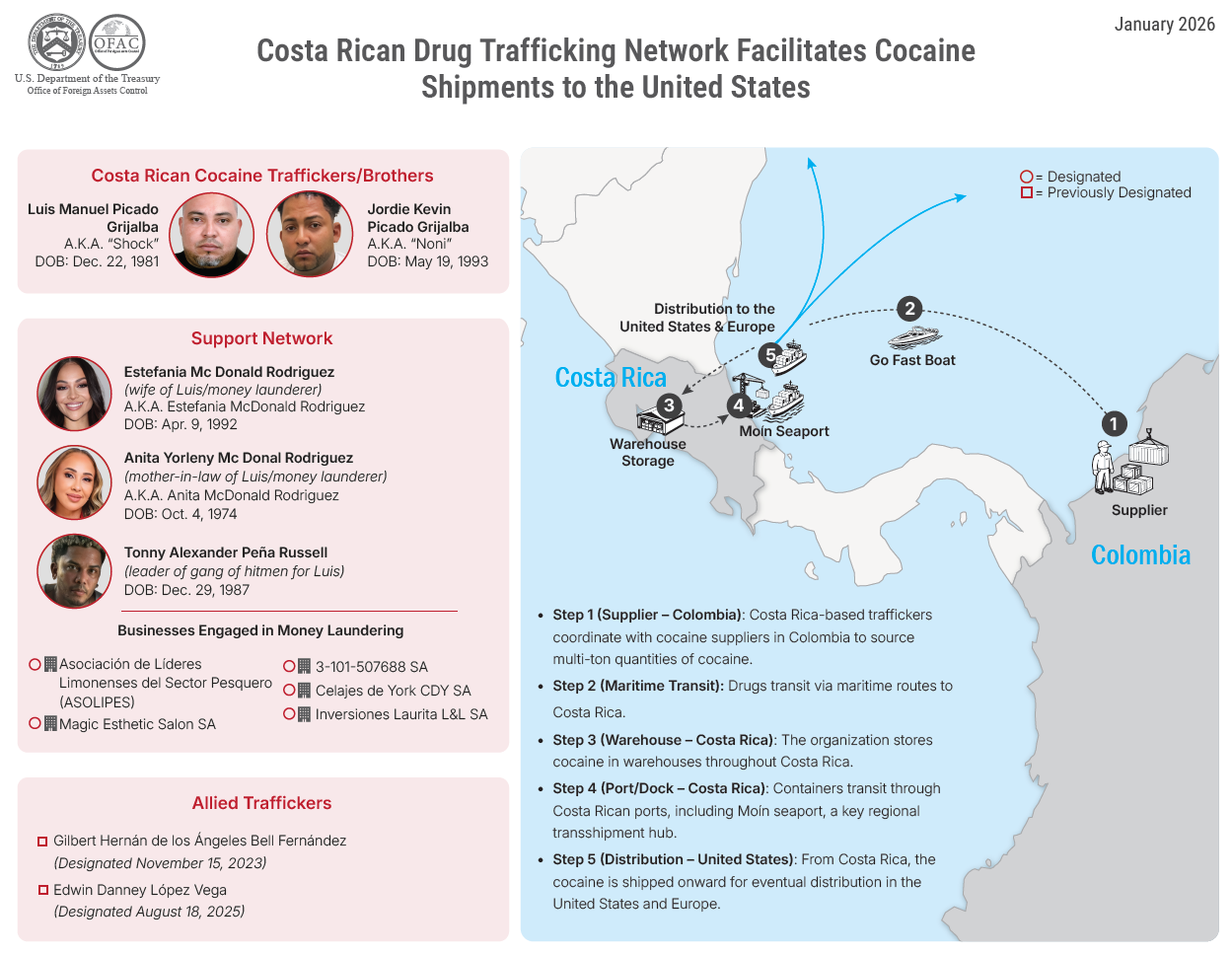
A FAMILY-RUN MONEY LAUNDERING NETWORK
In addition to these key alliances, Shock also worked closely with family members to facilitate his drug trafficking operations and launder illicit proceeds. Shock’s wife, Estefania Mc Donald Rodriguez (Estefania McDonald Rodriguez), and his mother-in-law, Anita Yorleny Mc Donal Rodriguez (a.k.a. Anita McDonald Rodriguez), used their businesses to launder money for Shock. Anita McDonald Rodriguez also notarized fraudulent transactions on Shock’s behalf.
Estefania McDonald Rodriguez and Anita McDonald Rodriguez are being designated pursuant to E.O. 14059 for being owned, controlled, or directed by, or having acted or purported to act for or on behalf of, directly or indirectly, Luis Manuel Picado Grijalba.
The companies operated by Estefania McDonald and Anita McDonald to facilitate Shock’s criminal activities include: Asociación de Lideres Limonenses del Sector Pesquero (ASOLIPES), 3-101-507688 SA, Celajes de York CDY SA (Celajes de York CDY), Magic Esthetic Salon SA (Magic Esthetic Salon), and Inversiones Laurita L&L SA (Inversiones Laurita L&L). ASOLIPES, 3-101-507688 SA, and Inversiones Laurita L&L have been temporarily suspended by Costa Rican authorities due to their links to money laundering and drug trafficking.
Asociación de Líderes Limonenses del Sector Pesquero is being designated pursuant to E.O. 14059 for being owned, controlled, or directed by, or having acted or purported to act for or on behalf of, directly or indirectly, Anita McDonald Rodriguez.
3-101-507688 SA, Celajes de York CDY SA, and Inversiones Laurita L&L SA are being designated pursuant to E.O. 14059 for being owned, controlled, or directed by, or having acted or purported to act for or on behalf of, directly or indirectly, Estefania McDonald Rodriguez.
Magic Esthetic Salon SA is being designated pursuant to E.O. 14059 for being owned, controlled, or directed by, or having acted or purported to act for or on behalf of, directly or indirectly, Estefania McDonald Rodriguez and Anita McDonald Rodriguez.
SANCTIONS IMPLICATIONS
As a result of today’s action, all property and interests in property of the designated or blocked persons described above that are in the United States or in the possession or control of U.S. persons are blocked and must be reported to OFAC. In addition, any entities that are owned, directly or indirectly, individually or in the aggregate, 50 percent or more by one or more blocked persons are also blocked. Unless authorized by a general or specific license issued by OFAC, or exempt, OFAC’s regulations generally prohibit all transactions by U.S. persons or within (or transiting) the United States that involve any property or interests in property of blocked persons.
Violations of U.S. sanctions may result in the imposition of civil or criminal penalties on U.S. and foreign persons. OFAC may impose civil penalties for sanctions violations on a strict liability basis. OFAC’s Economic Sanctions Enforcement Guidelines provide more information regarding OFAC’s enforcement of U.S. economic sanctions. In addition, financial institutions and other persons may risk exposure to sanctions for engaging in certain transactions or activities involving designated or otherwise blocked persons. The prohibitions include the making of any contribution or provision of funds, goods, or services by, to, or for the benefit of any designated or blocked person, or the receipt of any contribution or provision of funds, goods, or services from any such person. Non-U.S. persons are also prohibited from causing or conspiring to cause U.S. persons to wittingly or unwittingly violate U.S. sanctions, as well as engaging in conduct that evades U.S. sanctions.
The power and integrity of OFAC sanctions derive not only from OFAC’s ability to designate and add persons to the Specially Designated Nationals and Blocked Persons List (SDN List), but also from its willingness to remove persons from the SDN List consistent with the law. The ultimate goal of sanctions is not to punish, but to bring about a positive change in behavior. For information concerning the process for seeking removal from an OFAC list, including the SDN List, or to submit a request, please refer to OFAC’s guidance on Filing a Petition for Removal from an OFAC List.
To view the chart on the persons designated today, click here.
For more information on the persons designated today, click here.