


Cartel del Noreste Exerts Influence Around Laredo, Texas Port of Entry
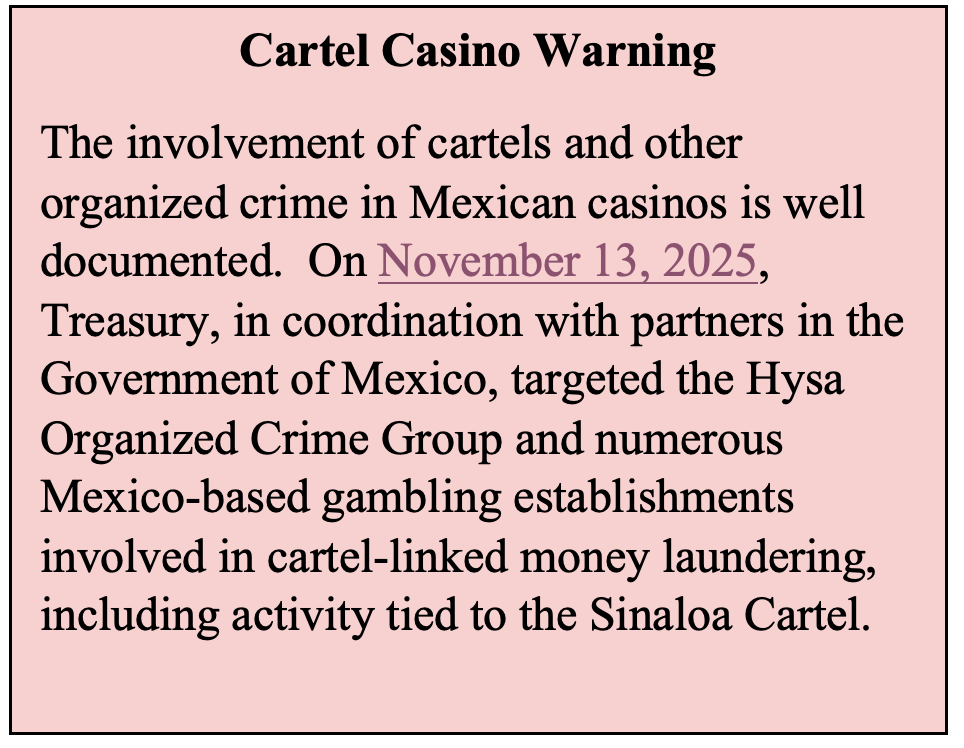
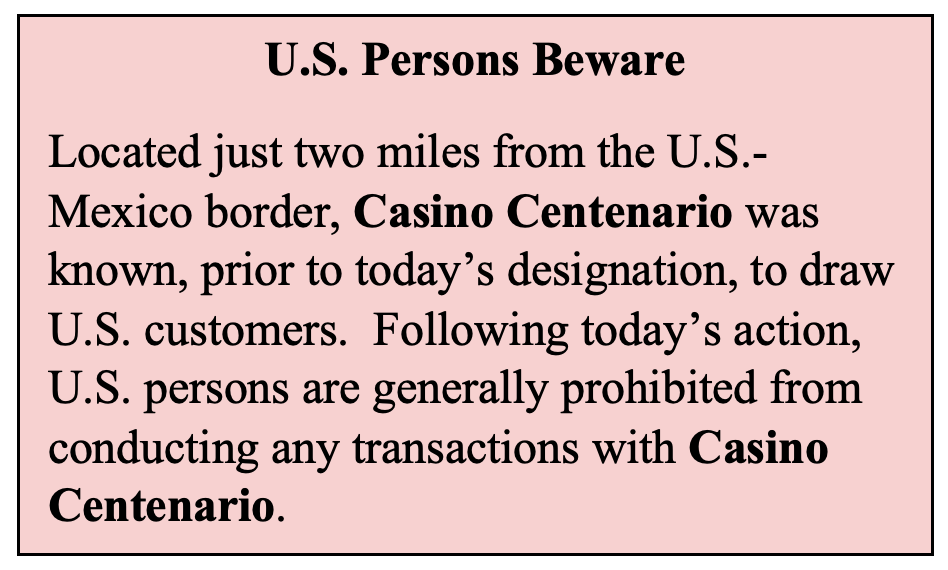
WASHINGTON—Today, the U.S. Department of the Treasury’s Office of Foreign Assets Control (OFAC) sanctioned six targets involved in a money laundering and cash smuggling enterprise operated by Cartel del Noreste (CDN), one of Mexico’s most violent drug trafficking organizations. CDN is a U.S.-designated Foreign Terrorist Organization (FTO) that exerts significant influence along the U.S.-Mexico border near Laredo, Texas, the busiest land port of entry on the southern border. The three individuals designated today play central roles in advancing CDN’s criminal dominance over the Nuevo Laredo plaza in Tamaulipas, Mexico, supporting the cartel’s broader illicit operations, which include fentanyl trafficking, human smuggling, money laundering, and extortion. Today’s action also targets two CDN-affiliated casinos, one of which is located just two miles from the U.S. border.
“As President Trump has made clear, Treasury will use all tools to protect our nation from violent cartels looking to reign terror on innocent Americans,” said Secretary of the Treasury Scott Bessent. “Treasury will continue to target the diverse revenue streams that cartels rely on to sustain their operations, which include trafficking fentanyl and illegal aliens into the United States.”
Today’s action reflects the culmination of a coordinated Homeland Security Task Force (HSTF)-led investigation involving the Drug Enforcement Administration’s (DEA) Laredo District Office and San Antonio Division Office. OFAC works in close coordination with the HSTFs, which target the proliferation of illicit drugs and the networks, enablers, and financial mechanisms that support their production and distribution.
The action was taken pursuant to Executive Order (E.O.) 14059, which targets the international proliferation of illicit drugs and their means of production, and pursuant to E.O. 13224, as amended, which targets terrorists and their supporters. This is OFAC’s third action targeting CDN’s leadership and affiliates during the Trump Administration. On May 21, 2025, OFAC designated two high-ranking members and arms traffickers of CDN. On August 6, 2025, OFAC designated three high-ranking members of CDN and infamous narco-rapper El Makabelico, who provided support to CDN by using streaming platforms and concerts to generate revenue and launder money for the cartel.
CARTEL DEL NORESTE’S CAMPAIGN OF TERROR ON THE BORDER
CDN is primarily based in the Mexican states of Tamaulipas, Coahuila, and Nuevo Leon. For decades, CDN has been involved in the trafficking of narcotics and other illicit drugs, including fentanyl, crystal methamphetamine, heroin, marijuana, and cocaine. CDN is involved in violent criminal activity on both sides of the border, including the kidnapping and killing of individuals that threaten their criminal enterprise on the southern border. With a stronghold in Nuevo Laredo, CDN uses its terror-fueled influence in the region to control drug trafficking and human smuggling routes, bribe politicians and journalists, and extort local businesses and shipments flowing to and from the United States at the busiest inland point of entry for trade in the United States.
CDN, previously known as Los Zetas, was identified by the United States as a specially designated foreign narcotics trafficker on April 15, 2009 pursuant to the Foreign Narcotics Kingpin Designation Act (Kingpin Act). On July 24, 2011, Los Zetas was named as a transnational criminal organization (TCO) in the annex to E.O. 13581. On December 15, 2021, OFAC designated CDN pursuant to E.O. 14059. On February 20, 2025, the U.S. Department of State designated CDN as a Foreign Terrorist Organization (FTO) and as a Specially Designated Global Terrorist (SDGT).
THE HOUSE LOSES: DISMANTLING CDN CASINO VENTURES

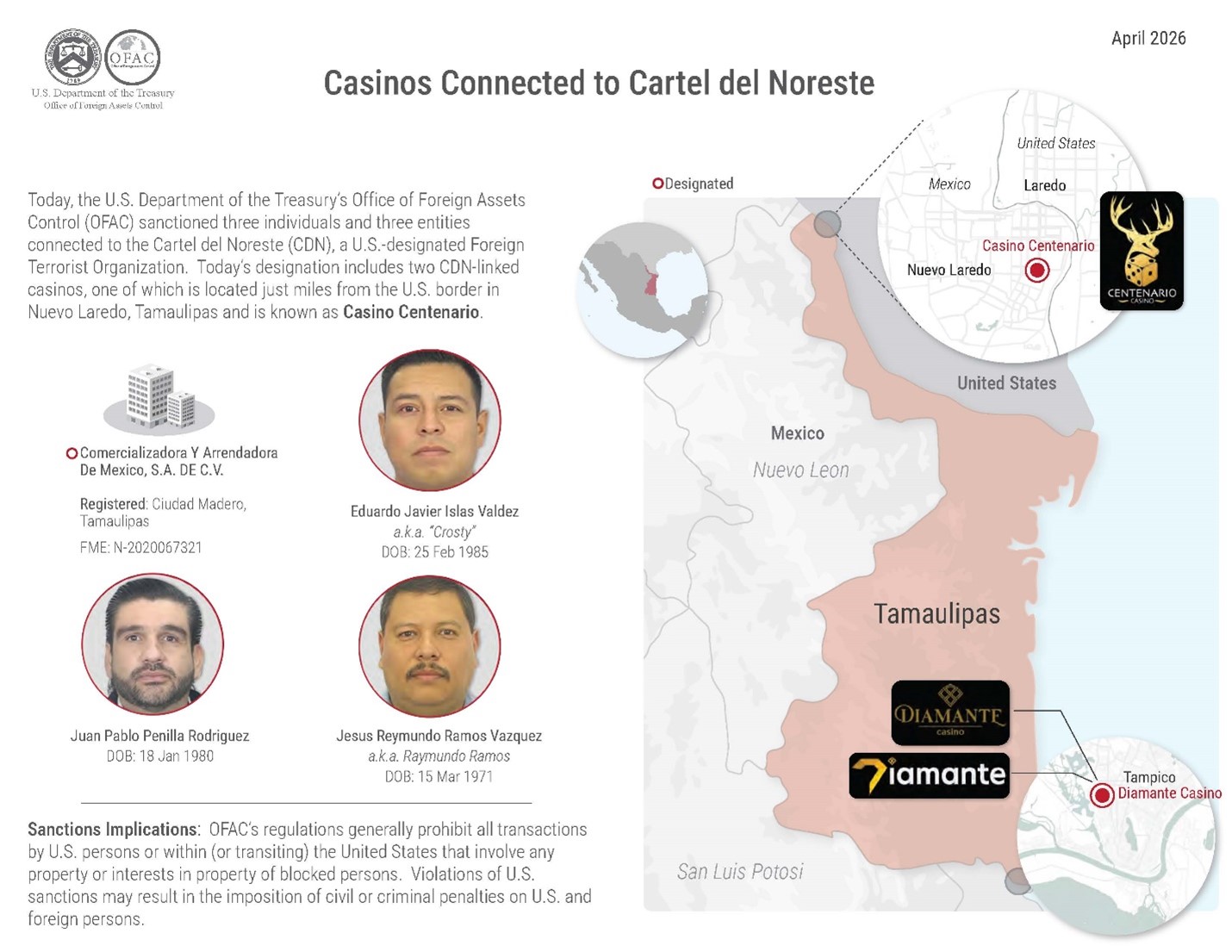
Today, OFAC designated Casino Centenario, a Nuevo Laredo, Tamaulipas-based casino. Operated by the entity Comercializadora y Arrendadora de Mexico, S.A. de C.V. (CAMSA), Casino Centenario is utilized by CDN as a stash house for fentanyl pills and cocaine, as well as a vehicle to launder illicit proceeds and integrate them into the legitimate financial system through its gaming operations. CDN also uses the backrooms of Casino Centenario to torture and intimidate alleged enemies of the cartel. Many CDN members also frequent Casino Centenario.
 OFAC designated Casino Centenario pursuant to E.O. 14059 for having materially assisted, sponsored, or provided financial, material, or technological support for, or goods or services in support of, CDN. Casino Centenario is also being designated pursuant to E.O. 13224, as amended, for having materially assisted, sponsored, or provided financial, material, or technological support for, or goods or services to or in support of, CDN.
OFAC designated CAMSA pursuant to E.O. 14059, for having provided, or attempted to provide, financial, material, or technological support for, or goods or services in support of Casino Centenario. CAMSA is also being designated pursuant to E.O. 13224, as amended, for having materially assisted, sponsored, or provided financial, material, or technological support for, or goods or services to or in support of, Casino Centenario.

CAMSA also operates Diamante Casino, which has a location in Tampico, Tamaulipas and a gambling website with the same name (diamantecasino.com.mx). Diamante Casino is being designated pursuant to E.O. 14059, and pursuant to E.O. 13224, as amended, for being owned, controlled, or directed by, or having acted or purported to act for or on behalf of, directly or indirectly, CAMSA.
DISRUPTING CARTEL DEL NORESTE BORDER OPERATIONS
OFAC today designated Eduardo Javier Islas Valdez (Islas), also known as “Crosty,” who is in charge of CDN human smuggling operations in Nuevo Laredo. Islas oversees human smugglers, known as pateros, and grants permission to move the migrants, acting as a gatekeeper for human smuggling along the Rio Grande into Texas. Islas also ensures the continuity of cross-border activities that sustain the cartel’s criminal enterprise by controlling cash stash houses in Nuevo Laredo. Islas is a close associate of CDN second-in-command Abdon Federico Rodriguez Garcia, who OFAC designated in August 2025.
OFAC designated Islas pursuant to E.O. 14059 and pursuant to E.O. 13224, as amended, for being owned, controlled, or directed by, or having acted or purported to act for or on behalf of, directly or indirectly, CDN.
EXPOSING PROMINENT CARTEL ENABLERS
CDN has many high-profile associates that conceal their criminality behind the appearance of their public-facing, legitimate, and otherwise seemingly honorable professions. Using their positions as cover, these individuals attempt to gain the public’s trust, while working behind the scenes to strengthen CDN’s control over Nuevo Laredo, Tamaulipas, and the surrounding border region.
Juan Pablo Penilla Rodriguez (Penilla), a defense attorney, provides illegal services to CDN members beyond the scope of a normal attorney-client relationship. While representing Miguel Angel “Z-40” Trevino Morales, Penilla has assisted Miguel Trevino in Mexican prison—despite OFAC’s sanctions against him—by serving as his intermediary to the current leadership of CDN and other criminal associates. This facilitation has enabled Miguel Trevino to maintain his leadership role in the cartel despite his incarceration. The criminal operations of Miguel Trevino, and CDN as a whole, rely directly on Penilla. Miguel Trevino is in U.S. custody.
Jesus Reymundo Ramos Vazquez (Ramos), better known as Raymundo Ramos, is a CDN associate that leads the CDN disinformation campaign against Mexican authorities while posing as a “human rights” activist. Under the guise of human rights activism, Ramos solely advocates for violent cartel members by filing false complaints against the Mexican military, paying individuals to attend protests, and protecting the reputations of fallen or arrested CDN members. On the CDN payroll, Ramos engages in these activities with the goal of boosting the public opinion of CDN and discrediting Mexican authorities’ law enforcement initiatives against the cartel. Ramos has supported CDN in this capacity for over a decade.
OFAC designated Penilla and Ramos pursuant to E.O. 14059, and pursuant to E.O. 13224, as amended, for being owned, controlled, or directed by, or having acted or purported to act for or on behalf of, directly or indirectly, CDN.
SANCTIONS IMPLICATIONS
As a result of today’s action, all property and interests in property of the designated or blocked persons described above that are in the United States or in the possession or control of U.S. persons are blocked and must be reported to OFAC. In addition, any entities that are owned, directly or indirectly, individually or in the aggregate, 50 percent or more by one or more blocked persons are also blocked. Unless authorized by a general or specific license issued by OFAC, or exempt, OFAC’s regulations generally prohibit all transactions by U.S. persons or within (or transiting) the United States that involve any property or interests in property of blocked persons.
Violations of U.S. sanctions may result in the imposition of civil or criminal penalties on U.S. and foreign persons. OFAC may impose civil penalties for sanctions violations on a strict liability basis. OFAC’s Economic Sanctions Enforcement Guidelines provide more information regarding OFAC’s enforcement of U.S. economic sanctions. In addition, financial institutions and other persons may risk exposure to sanctions for engaging in certain transactions or activities involving designated or otherwise blocked persons. The prohibitions include the making of any contribution or provision of funds, goods, or services by, to, or for the benefit of any designated or blocked person, or the receipt of any contribution or provision of funds, goods, or services from any such person. Non-U.S. persons are also prohibited from causing or conspiring to cause U.S. persons to wittingly or unwittingly violate U.S. sanctions, as well as engaging in conduct that evades U.S. sanctions. Individuals located in the U.S. or abroad who provide information about sanctions violations to Treasury’s FinCEN’s whistleblower incentive program may be eligible for awards if the information they provide leads to a successful enforcement action that results in monetary penalties exceeding $1,000,000.
Furthermore, engaging in certain transactions involving the persons designated today may risk the imposition of secondary sanctions on participating foreign financial institutions. OFAC can prohibit or impose strict conditions on opening or maintaining, in the United States, a correspondent account or a payable-through account of a foreign financial institution that knowingly conducts or facilitates any significant transaction on behalf of a person who is designated pursuant to the relevant authority.
The power and integrity of OFAC sanctions derive not only from OFAC’s ability to designate and add persons to the Specially Designated Nationals and Blocked Persons List (SDN List), but also from its willingness to remove persons from the SDN List consistent with the law. The ultimate goal of sanctions is not to punish, but to bring about a positive change in behavior. For information concerning the process for seeking removal from an OFAC list, including the SDN List, or to submit a request, please refer to OFAC’s guidance on Filing a Petition for Removal from an OFAC List.
OFAC has also issued a general license supporting ordinarily incident and necessary transactions to wind down operations with CAMSA, Casino Centenario, and/or Diamante Casino by U.S. persons.
To view the chart on the persons designated today, click here.
Click here for more information on the persons designated today.
###