


WASHINGTON—Today, the U.S. Department of the Treasury’s Office of Foreign Assets Control (OFAC) sanctioned a timeshare fraud network led by the terrorist Cartel de Jalisco Nueva Generacion (CJNG). The action targets Kovay Gardens, a Mexican timeshare resort, as well as five Mexican individuals and 17 Mexican companies associated with the network. Many of these individuals and entities are based in or near Puerto Vallarta, a popular tourist destination that also serves as a strategic stronghold for CJNG. CJNG is a brutally violent terrorist cartel that continues to diversify its illicit revenue streams beyond drug trafficking, including through timeshare fraud and fuel theft. These activities generate significant proceeds for the organization at the expense of U.S. citizen victims. Timeshare fraud often targets vulnerable older Americans and can defraud victims of their life savings.
“Whether through trafficking fentanyl into our borders or orchestrating timeshare fraud schemes, terrorist drug cartels like CJNG consistently victimize Americans for profit,” said Secretary of the Treasury Scott Bessent. “Under President Trump’s leadership, we will continue our efforts to completely eradicate the cartels’ ability to generate revenue and terrorize Americans.”
Timeshare fraud in Mexico has plagued American victims for decades, costing them hundreds of millions of dollars while enriching criminal organizations such as CJNG. Over the past three years, Treasury Department components—including OFAC and the Financial Crimes Enforcement Network (FinCEN)—have undertaken a sustained effort to expose and counter this threat. These efforts have increased awareness and led to enhanced reporting of suspicious activity by U.S. financial institutions. In addition to Treasury’s actions, Department of Justice investigations have resulted in recent indictments related to timeshare fraud schemes conducted by CJNG members.
Today’s action was taken pursuant to Executive Order (E.O.) 14059, which targets the proliferation of illicit drugs and their means of production, and pursuant to E.O. 13224, as amended, which targets terrorists and their supporters. Today’s action reflects the culmination of a coordinated Homeland Security Task Force (HSTF)-New York led investigation involving the Federal Bureau of Investigation (FBI), the Drug Enforcement Administration (DEA), Internal Revenue Service Criminal Investigation (IRS-CI), and U.S. Customs and Border Protection (CBP). OFAC works in close coordination with the HSTF, which targets the proliferation of illicit drugs and the networks, enablers, and financial mechanisms that support their production and distribution. This unified, whole-of-government approach ensures operational coordination to maximize the impact against transnational criminal networks. Additionally, OFAC coordinated on this action with the Government of Mexico’s financial intelligence unit, the Unidad de Inteligencia Financiera (UIF).
CJNG: VIOLENCE IN PURSUIT OF PROFIT
CJNG is considered one of the most powerful cartels in the world. It has conducted intimidating acts of violence, including attacks on the Mexican military and police with military-grade weaponry, the use of drones to drop explosives on Mexican law enforcement, and both assassinations and attempted assassinations of Mexican officials. CJNG has also executed its own recruits who defy orders. All of these acts are perpetrated in furtherance of CJNG’s relentless pursuit of illicit proceeds. In addition to drug trafficking—the group’s core source of revenue—CJNG is also generating revenue through fuel theft, extortion, and timeshare fraud, among other activities.
On April 8, 2015, OFAC designated CJNG pursuant to the Foreign Narcotics Kingpin Designation Act (Kingpin Act) for playing a significant role in international narcotics trafficking. On December 15, 2021, OFAC also designated CJNG pursuant to E.O. 14059. On February 20, 2025, the U.S. Department of State designated CJNG as an Foreign Terrorist Organization and a Specially Designated Global Terrorist.
BANDITS IN THE BAHIA DE BANDERAS
For decades, Mexico-based cartels have been targeting U.S. owners of timeshares through call centers in Mexico staffed by telemarketers fluent in English. Beginning in or about 2012, CJNG took control of timeshare fraud schemes in Puerto Vallarta, Jalisco, Mexico, and the surrounding area, known as the Bahia de Banderas. These complex scams often target older Americans who can lose their life savings. The lifecycle of these scams can last years, resulting in financial and emotional devastation of the victims while enriching cartels like CJNG.
The cartels generally obtain information about U.S. owners of timeshares in Mexico from complicit insiders at timeshare resorts. After obtaining information on timeshare owners, the cartels, through their call centers, contact victims by phone or email and claim to be U.S.-based third-party timeshare brokers, attorneys, or sales representatives in the timeshare, travel, real estate, or financial services industries. The fraud may include timeshare exit scams (a.k.a. timeshare resale scams), timeshare re-rent scams, and timeshare investment scams. The common theme is that victims are asked to pay advance “fees” and “taxes” before receiving money supposedly owed to them. This money never comes, and the victims are continuously told to pay additional “fees” and “taxes” to finalize the transactions. Victims are typically told to send the money via international wire transfers to accounts held at Mexican banks and brokerage houses.
Timeshare Warning
Current owners of timeshares in Mexico should be aware: If an unsolicited purchase or rental offer seems too good to be true, it probably is. Those considering the purchase of a timeshare in Mexico should conduct appropriate due diligence.
After these initial scams, re-victimization scams can occur. The scammers may impersonate law firms, claiming that they can initiate proceedings on behalf of the victims to recover lost funds for an upfront fee. In other instances, scammers impersonate government officials, claiming that victims have engaged in suspicious transactions and demanding “fines” to release their funds or face the risk of imprisonment. OFAC issued an alert in March 2023 regarding such scams, warning that individuals may falsely claim to represent OFAC in furtherance of their fraud.
Treasury’s Financial Crimes Enforcement Network (FinCEN), OFAC, and the FBI previously issued a joint Notice on timeshare fraud associated with Mexico-based transnational criminal organizations to provide financial institutions with an overview of these schemes, associated financial typologies, and red flag indicators. Since the Notice was published, FinCEN received over 850 Suspicious Activity Reports that cite the Notice. Together, these Suspicious Activity Reports identified approximately $330 million in suspicious activity potentially related to timeshare fraud. On average, FinCEN receives approximately 40 Suspicious Activity Reports each month associated with possible timeshare fraud, with each reporting an average of $383,000 and median of $42,000 in suspicious activity. This activity primarily consists of U.S.-based individuals sending funds to suspected scammers in Mexico who potentially work for Mexico-based transnational criminal organizations.
Victim Resources
On its website, the FBI has included a timeshare fraud resource page, and FBI’s New York Field Office has posted a public service announcement video featuring a victim of timeshare fraud. Victims of timeshare fraud are encouraged to file a complaint with the FBI’s IC3 by visiting https://www.ic3.gov. For older victims, financial institutions may also refer their customers to the U.S. Department of Justice’s National Elder Fraud Hotline at 833-FRAUD-11 (or 833-372-8311).
According to the FBI, approximately 6,000 U.S. victims reported losing nearly $300 million between 2019 and 2023 to timeshare fraud schemes in Mexico. In 2024 alone, FBI’s Internet Crime Complaint Center (IC3) received nearly 900 complaints concerning timeshare fraud schemes in Mexico, with reported losses of over $50 million. However, these figures likely underestimate total losses, as the FBI believes the vast majority of victims do not report the scam due to embarrassment, among other reasons.
VERTICALLY INTEGRATED TIMESHARE FRAUD
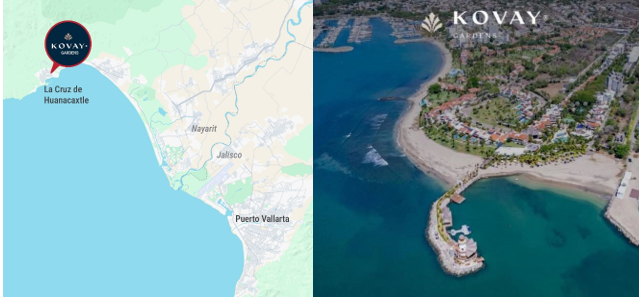
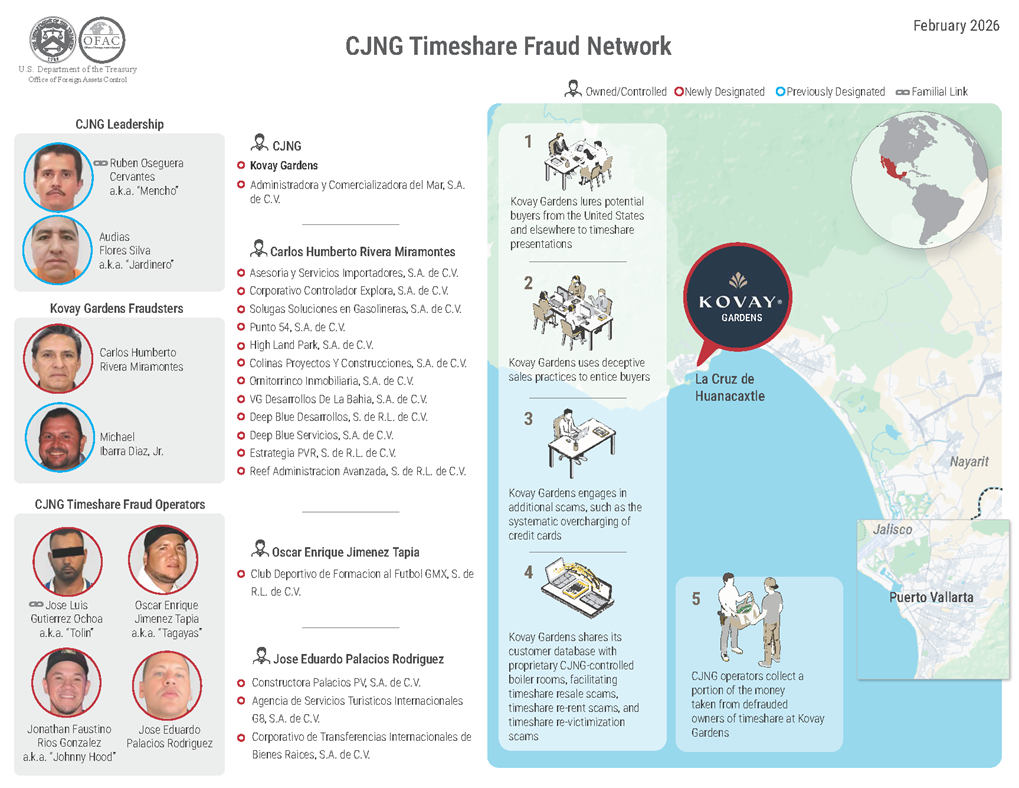
By controlling a timeshare resort, CJNG can defraud timeshare owners in various ways from the moment they sign a contract and for years to come. This is the case with the CJNG-controlled Kovay Gardens, a timeshare resort located northwest of Puerto Vallarta in La Cruz de Huanacaxtle, Nayarit. Kovay Gardens uses underhanded tactics, including robocalls, to lure potential buyers to presentations, where it uses deceptive sales practices to entice buyers. For example, Kovay Gardens falsely promises that its timeshare owners can generate income by renting out their unused weeks. Additionally, Kovay Gardens engages in other scams, such as the systematic overcharging of credit cards. After these initial frauds, Kovay Gardens shares its customer database with CJNG-controlled boiler rooms, or call centers, that conduct timeshare resale, re-rent, and re-victimization frauds described above. This vertically integrated timeshare fraud model allows CJNG to efficiently and repeatedly victimize Kovay Gardens timeshare owners, who are often U.S. persons. Kovay Gardens is being sanctioned pursuant to E.O. 14059 and pursuant to E.O. 13224, as amended, for being directed by, or having acted or purported to act for or on behalf of, directly or indirectly, CJNG.

Also sanctioned today is Administradora y Comercializadora del Mar, S.A. de C.V., which provides a number of services to Kovay Gardens, including the processing of hotel reservations. Administradora y Comercializadora del Mar, S.A. de C.V. is being sanctioned pursuant to E.O. 14059 and pursuant to E.O. 13224, as amended, for being directed by, or having acted or purported to act for or on behalf of, directly or indirectly, Kovay Gardens.
CJNG’s timeshare fraud activities at Kovay Gardens are conducted in part through the resort’s founder, Carlos Humberto Rivera Miramontes (Rivera Miramontes). Rivera Miramontes, who has a lengthy history of willingly working with drug traffickers, opened Kovay Gardens over 20 years ago under its original name—Vallarta Gardens. Rivera Miramontes works closely with CJNG-affiliated businessman Michael Ibarra Diaz Jr., who OFAC previously designated, to facilitate timeshare sales to American and Canadian tourists who are subsequently defrauded. Multiple lawsuits have alleged that Rivera Miramontes and Kovay Gardens have engaged in fraudulent activity. Rivera Miramontes is being sanctioned pursuant to E.O. 14059 and pursuant to E.O. 13224, as amended, for being directed by, or having acted or purported to act for or on behalf of, directly or indirectly, CJNG.
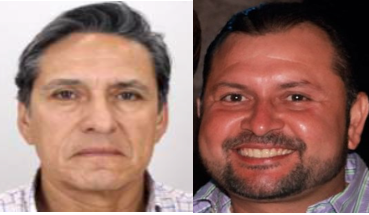
Also sanctioned today is Rivera Miramontes’ corporate network, which is composed of 13 companies. Two of the companies—Punto 54, S.A. de C.V. and High Land Park, S.A. de C.V.—claim to operate in the tourism industry. Another three companies claim to be engaged in real estate activities: Colinas Proyectos Y Construcciones, S.A. de C.V., Ornitorrinco Inmobiliaria, S.A. de C.V., and VG Desarrollos De La Bahia, S.A. de C.V. In addition, four of the companies are purportedly operating in the financial services sector: Deep Blue Desarrollos, S. de R.L. de C.V., Deep Blue Servicios, S.A. de C.V., Estrategia PVR, S. de R.L. de C.V., and Reef Administracion Avanzada, S. de R.L. de C.V. This diverse corporate network also includes a business services company (Asesoria y Servicios Importadores, S.A. de C.V.), a holding company (Corporativo Controlador Explora, S.A. de C.V.), and a fuel company (Solugas Soluciones en Gasolineras, S.A. de C.V.). These 13 companies are being sanctioned pursuant to E.O. 14059 and pursuant to E.O. 13224, as amended, for being owned, controlled, or directed by, or having acted or purported to act for or on behalf of, directly or indirectly, Rivera Miramontes. Hotel Management International, LLC is a Texas-based entity that is owned by Rivera Miramontes. Hotel Management International, LLC is being identified as blocked for being property in which Rivera Miramontes, a person whose property and interest in property are blocked pursuant to E.O. 14059 and pursuant to E.O. 13224, has an interest.
CJNG CONTROL IN NAYARIT
Timeshare fraud operations in Nayarit are controlled by CJNG operatives acting on behalf of Audias Flores Silva (Flores Silva), the regional CJNG commander who was previously designated by OFAC. The U.S. State Department is offering $5 million for information leading to the arrest and/or conviction of Flores Silva. Flores Silva’s lieutenants who collect payment from boiler rooms in Nayarit, including those linked to Kovay Gardens, are Oscar Enrique Jimenez Tapia (alias “Tagayas”) and Jose Luis Gutierrez Ochoa (alias “Tolin”). Tolin has close familial connections to Ruben Oseguera Cervantes (alias “Mencho”), the ultimate leader of CJNG who is the subject of a $15 million reward offer from the U.S. Department of State. Subordinate to Tagayas are Jonathan Faustino Rios Gonzalez (alias “Johnny Hood”) and Jose Eduardo Palacios Rodriguez (Palacios Rodriguez), who both operate timeshare fraud boiler rooms for CJNG. Tagayas, Tolin, Johnny Hood, and Palacios Rodriguez are being sanctioned pursuant to E.O. 14059 and pursuant to E.O. 13224, as amended, for being directed by, or having acted or purported to act for or on behalf of, directly or indirectly, CJNG.
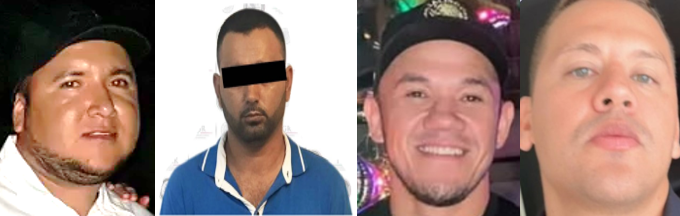
In addition, sanctioned today are three real estate companies owned by Palacios Rodriguez — Constructora Palacios PV, S.A. de C.V., Agencia de Servicios Turisticos Internacionales G8, S.A. de C.V., and Corporativo de Transferencias Internacionales de Bienes Raices, S.A. de C.V. These companies are being sanctioned pursuant to E.O. 14059 and pursuant to E.O. 13224, as amended, for being owned, controlled, or directed by, or having acted or purported to act for or on behalf of, directly or indirectly, Palacios Rodriguez.
OFAC also sanctioned Club Deportivo de Formacion al Futbol GMX, S. de R.L. de C.V., a sports club owned by Tagayas that is being sanctioned pursuant to E.O. 14059 and pursuant to E.O. 13224, as amended, for being owned, controlled, or directed by, or having acted or purported to act for or on behalf of, directly or indirectly, Tagayas.
PREVIOUS U.S. GOVERNMENT ACTIONS AGAINST CJNG TIMESHARE FRAUD
Today’s action marks the sixth time OFAC has sanctioned those linked, directly or indirectly, to CJNG’s timeshare fraud activities, resulting in the designation of over 90 individuals and entities to date.
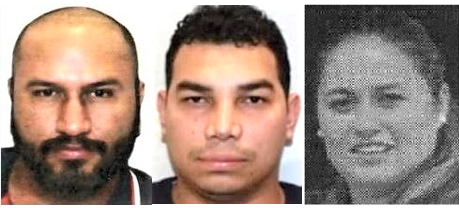
Among the CJNG members previously designated and linked to timeshare fraud are Julio Cesar Montero Pinzon (Montero), Carlos Andres Rivera Varela (Rivera), and Griselda Margarita Arredondo Pinzon (Arredondo). Montero and Rivera have also been part of a CJNG enforcement group based in Puerto Vallarta that orchestrates assassinations of rivals and politicians using high-powered weaponry. On October 27, 2025, a grand jury returned a superseding indictment in the United States District Court for the Eastern District of New York charging Montero and Rivera with Providing and Attempting to Provide Material Support to a Foreign Terrorist Organization and Conspiracy to Commit Money Laundering. Additionally, the superseding indictment charged Arredondo with Conspiracy to Commit Wire Fraud and Conspiracy to Commit Money Laundering. All the charges against these three individuals are related to their roles in running a timeshare fraud operation on behalf of CJNG.
SANCTIONS IMPLICATIONS
As a result of today’s action, all property and interests in property of the designated or blocked persons described above that are in the United States or in the possession or control of U.S. persons are blocked and must be reported to OFAC. In addition, any entities that are owned, directly or indirectly, individually or in the aggregate, 50 percent or more by one or more blocked persons are also blocked. Unless authorized by a general or specific license issued by OFAC, or exempt, OFAC’s regulations generally prohibit all transactions by U.S. persons or within (or transiting) the United States that involve any property or interests in property of blocked persons.
Violations of U.S. sanctions may result in the imposition of civil or criminal penalties on U.S. and foreign persons. OFAC may impose civil penalties for sanctions violations on a strict liability basis. OFAC’s Economic Sanctions Enforcement Guidelines provide more information regarding OFAC’s enforcement of U.S. economic sanctions. In addition, financial institutions and other persons may risk exposure to sanctions for engaging in certain transactions or activities involving designated or otherwise blocked persons. The prohibitions include the making of any contribution or provision of funds, goods, or services by, to, or for the benefit of any designated or blocked person, or the receipt of any contribution or provision of funds, goods, or services from any such person. Non-U.S. persons are also prohibited from causing or conspiring to cause U.S. persons to wittingly or unwittingly violate U.S. sanctions, as well as engaging in conduct that evades U.S. sanctions. Individuals located in the U.S. or abroad who provide information about sanctions violations to FinCEN’s whistleblower incentive program may be eligible for awards if the information they provide leads to a successful enforcement action that results in monetary penalties exceeding $1,000,000.
Furthermore, engaging in certain transactions involving the persons designated today may risk the imposition of secondary sanctions on participating foreign financial institutions. OFAC can prohibit or impose strict conditions on opening or maintaining, in the United States, a correspondent account or a payable-through account of a foreign financial institution that knowingly conducts or facilitates any significant transaction on behalf of a person who is designated pursuant to the relevant authority.
The power and integrity of OFAC sanctions derive not only from OFAC’s ability to designate and add persons to the Specially Designated Nationals and Blocked Persons List (SDN List), but also from its willingness to remove persons from the SDN List consistent with the law. The ultimate goal of sanctions is not to punish, but to bring about a positive change in behavior. For information concerning the process for seeking removal from an OFAC list, including the SDN List, or to submit a request, please refer to OFAC’s guidance on Filing a Petition for Removal from an OFAC List.
OFAC has also issued a general license supporting ordinarily incident and necessary transactions to wind down operations at Kovay Gardens by U.S. persons.
Click here for more information on the persons designated today.
Click here for a chart of the individuals and entities designated today.
###