


Sanctioned Company Linked to Sale of Millions of Dollars’ Worth of Combat Drones to Venezuela
WASHINGTON — Today, the U.S. Department of the Treasury’s Office of Foreign Assets Control (OFAC) is targeting 10 individuals and entities based in Venezuela and Iran, including a Venezuelan company that has contributed to Iran’s unmanned aerial vehicle (UAV) trade with Venezuela.
“Treasury is holding Iran and Venezuela accountable for their aggressive and reckless proliferation of deadly weapons around the world,” said Treasury Under Secretary for Terrorism and Financial Intelligence John K. Hurley. “We will continue to take swift action to deprive those who enable Iran’s military-industrial complex access to the U.S. financial system.”
This action builds on Treasury’s nonproliferation designations in October and November in support of the September 27, 2025 reimposition of United Nations sanctions and other restrictions on Iran. Iran’s UAV and missile programs threaten U.S. and allied personnel in the Middle East and destabilize commercial shipping in the Red Sea. Additionally, Iran’s ongoing provision of conventional weapons to Caracas constitutes a threat to U.S. interests in the Western Hemisphere, including the Homeland, and the United States will use all available measures to prevent this trade.
This action is being taken in furtherance of National Security Presidential Memorandum 2, which directs the U.S. government to curtail Iran’s ballistic missile program, counter Iran’s development of other asymmetric and conventional weapons capabilities, deny Iran a nuclear weapon, and deny the Islamic Revolutionary Guard Corps (IRGC) access to assets and resources that sustain their destabilizing activities. OFAC is taking this action pursuant to Executive Order (E.O.) 13382, which targets weapons of mass destruction (WMD) proliferators and their supporters, and E.O. 13949, which targets property of certain persons with respect to the conventional arms activities of Iran.
IRAN’S UAV TRADE WITH VENEZUELA
Today, OFAC is designating a Venezuelan company and its chair, which have acquired Iranian‑designed UAVs. Since 2006, Iran and Venezuela have coordinated Iran’s provision of Qods Aviation Industries’ (QAI) Mohajer-series UAVs for Venezuela, which are re-branded in Venezuela as ANSU-series UAVs. In October 2023, OFAC designated QAI pursuant to E.O. 13949 being owned or controlled by, or having acted or purported to act for or on behalf of, directly or indirectly, Iran’s Ministry of Defense and Armed Forces Logistics (MODAFL). In September 2020, the U.S. Department of State designated MODAFL pursuant to E.O. 13949 for engaging in activity that materially contributes to the supply, sale, or transfer, directly or indirectly, to or from Iran, or for the use in or benefit of Iran, of arms or related materiel, including spare parts.
Venezuela-based Empresa Aeronautica Nacional SA (EANSA) maintains and oversees the assembly of QAI’s Mohajer-series UAVs in Venezuela and has directly negotiated with QAI, contributing to QAI’s sale of millions of dollars’ worth of Mohajer-6 UAVs to Venezuela. The Mohajer-6, a combat UAV with intelligence, surveillance, and reconnaissance capabilities, is manufactured by QAI. EANSA was also involved in the assembly of aircraft that QAI sold to Venezuela.
EANSA maintains UAVs operated by the Venezuelan armed forces, including the Iranian Mohajer-2, known locally as Arpia or ANSU-100. The ANSU-100 is an updated, armed version of the Arpia-001, which is a direct derivative of QAI’s Mohajer-2 and the first UAV produced in Venezuela. The ANSU-100 is capable of launching Iranian-designed Qaem air-to-ground guided bombs.
EANSA is chaired by Venezuela-based Jose Jesus Urdaneta Gonzalez (Urdaneta). Urdaneta, on behalf of EANSA, has coordinated with members and representatives of the Venezuelan and Iranian armed forces on the production of UAVs in Venezuela.
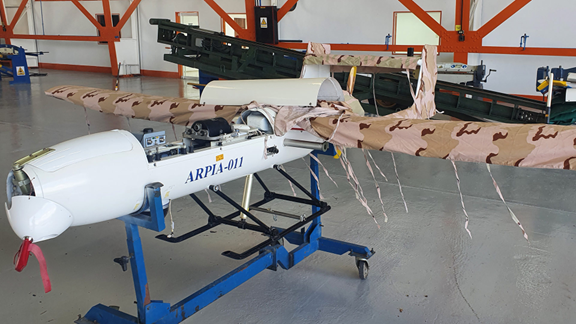
Figure 1: Partially Assembled Mohajer-2 UAV at El Libertador Air Base
EANSA is being designated pursuant to E.O. 13949 for having materially assisted, sponsored, or provided financial, material, or technological support for, or goods or services to or in support of, QAI. Urdaneta is being designated pursuant to E.O. 13949 for being owned or controlled by, or having acted or purported to act for or on behalf of, directly or indirectly, EANSA.
procurement efforts for parchin chemical industries
Today, OFAC is designating three Iran-based persons in connection with efforts to procure chemicals used for ballistic missiles—including sodium perchlorate, sebacic acid, and nitrocellulose—for Parchin Chemical Industries (PCI), an element of Iran’s Defense Industries Organization (DIO) that is responsible for the import and export of chemical goods. Sodium perchlorate is used to manufacture the Missile Technology Control Regime (MTCR)-controlled chemical ammonium perchlorate. Ammonium perchlorate is used in solid propellant rocket motors, which are commonly used for ballistic missiles. Sebacic acid is used to produce resins, which are materials sought by Iran for its ballistic missile program; and plasticizers, certain types of which are propellant additives and agents controlled by the MTCR. Nitrocellulose is used to improve the performance of solid propellant rocket motors.
OFAC designated PCI pursuant to the counterproliferation authority E.O. 13382 in July 2008, and the Department of State designated DIO pursuant to E.O. 13382 in March 2007. Both DIO and PCI are also subject to an asset freeze pursuant to United Nations Security Council Resolution (UNSCR) 1737 and UNSCR 1747, respectively.
Iran-based Mostafa Rostami Sani (Rostami Sani) has procured dozens of metric tons of sodium perchlorate for PCI in coordination with Marco Klinge (Klinge), Majid Dolatkhah (Dolatkhah), and MVM Amici Trading LLC (MVM Amici). Rostami Sani has also facilitated efforts to procure sodium perchlorate, sebacic acid, and nitrocellulose for PCI by serving as a liaison to PCI for Klinge and Dolatkhah.
OFAC recently designated Klinge and Dolatkhah pursuant to E.O. 13382 on November 12, 2025, for having provided, or attempted to provide, financial, material, technological or other support for, or goods or services in support of, PCI; OFAC concurrently designated MVM Amici pursuant to E.O. 13382 for being owned or controlled by, or acting or purporting to act for or on behalf of, directly or indirectly, Klinge.
Rostami Sani is the chairman of the board of directors of Iran-based Pardisan Rezvan Shargh International Private Joint Stock Company (Pardisan Rezvan Shargh). Rostami Sani has served multiple terms as Pardisan Rezvan Shargh’s chairman and served as its founding managing director. Iran-based Reza Zarepour Taraghi (Zarepour Taraghi) is the managing director of Pardisan Rezvan Shargh and serves as a member of the company’s board of directors.
Rostami Sani is being designated pursuant to E.O. 13382 for having provided, or attempted to provide, financial, material, technological or other support for, or goods or services in support of, PCI. Pardisan Rezvan Shargh is being designated pursuant to E.O. 13382 for being owned or controlled by, or acting or purporting to act for or on behalf of, directly or indirectly, Rostami Sani. Zarepour Taraghi is being designated pursuant to E.O. 13382 for being owned or controlled by, or acting or purporting to act for or on behalf of, directly or indirectly, Pardisan Rezvan Shargh.
RAYAN FAN GROUP Defense Conglomerate
OFAC is designating two entities and three individuals based in Iran for their connection to Rayan Fan Kav Andish Co (RFKA, or Rayan Fan Group), a U.S.-designated holding company for a variety of firms that operate in the field of high-technology systems. RFKA owns Rayan Roshd Afzar Company (RRA), which produced components for the IRGC’s UAV program and software for the IRGC’s aerospace program.
RFKA is a principal shareholder of Iran-based Fanavari Electro Moj Mobin Company (Fanavari) and is represented by U.S.-designated Mohsen Parsajam (Parsajam) as the chairman and a member of Fanavari’s board of directors. U.S.-designated Seyyed Reza Ghasemi (Ghasemi) and Farshad Hakemzadeh (Hakemzadeh) serve as members of Fanavari’s board of directors alongside Iran-based Bahram Rezaei (Rezaei), who serves as Fanavari’s managing director.
OFAC designated RFKA pursuant to E.O. 13382 in May 2024 for being owned or controlled by, or acting or purporting to act for or on behalf of, directly or indirectly, Parsajam. In July 2017, OFAC designated RRA pursuant to E.O. 13382 for having provided, or attempted to provide, financial, material, technological or other support for, or goods or services in support of, Iran’s IRGC. OFAC concurrently designated Parsajam, Ghasemi, and Hakemzadeh pursuant to E.O. 13382 for being owned or controlled by, or acting or purporting to act for or on behalf of, directly or indirectly, RRA.
Fanavari is being designated pursuant to E.O. 13382 for being owned or controlled by, or acting or purporting to act for or on behalf of, directly or indirectly, RFKA. Rezaei is being designated pursuant to E.O. 13382 for being owned or controlled by, or acting or purporting to act for or on behalf of, directly or indirectly, Fanavari.
Rezaei is the majority shareholder and chairman of the board of directors of Iran-based Kavoshgaran Asman Moj Ghadir Company (KAMG). Iran-based Erfan Qaysari (Qaysari) is the managing director for KAMG, and Iran-based Mehdi Ghaffari (Ghaffari) serves as the vice chairman of KAMG’s board of directors.
KAMG is being designated pursuant to E.O. 13382 for being owned or controlled by, or acting or purporting to act for or on behalf of, directly or indirectly, Rezaei. Qaysari and Ghaffari are being designated pursuant to E.O. 13382 for being owned or controlled by, or acting or purporting to act for or on behalf of, directly or indirectly, KAMG.
SANCTIONS IMPLICATIONS
As a result of today’s action, all property and interests in property of the designated or blocked persons described above that are in the United States or in the possession or control of U.S. persons are blocked and must be reported to OFAC. In addition, any entities that are owned, directly or indirectly, individually or in the aggregate, 50 percent or more by one or more blocked persons are also blocked. Unless authorized by a general or specific license issued by OFAC, or exempt, OFAC’s regulations generally prohibit all transactions by U.S. persons or within (or transiting) the United States that involve any property or interests in property of blocked persons.
Violations of U.S. sanctions may result in the imposition of civil or criminal penalties on U.S. and foreign persons. OFAC may impose civil penalties for sanctions violations on a strict liability basis. OFAC’s Economic Sanctions Enforcement Guidelines provide more information regarding OFAC’s enforcement of U.S. economic sanctions. In addition, financial institutions and other persons may risk exposure to sanctions for engaging in certain transactions or activities with designated or otherwise blocked persons.
Furthermore, engaging in certain transactions involving the persons designated today may risk the imposition of secondary sanctions on participating foreign financial institutions. OFAC can prohibit or impose strict conditions on opening or maintaining, in the United States, a correspondent account or a payable-through account of a foreign financial institution that knowingly conducts or facilitates any significant transaction on behalf of a person who is designated pursuant to the relevant authority.
The power and integrity of OFAC sanctions derive not only from OFAC’s ability to designate and add persons to the SDN List, but also from its willingness to remove persons from the SDN List consistent with the law. The ultimate goal of sanctions is not to punish, but to bring about a positive change in behavior. For information concerning the process for seeking removal from an OFAC list, including the SDN List, or to submit a request, please refer to OFAC’s guidance on Filing a Petition for Removal from an OFAC List.
Click here for more information on the persons designated today.
###